Foam Rollers, Exercise Balls, and Home Rehab Tools: What Actually Helps
· Keep It Kinetic Chiropractic
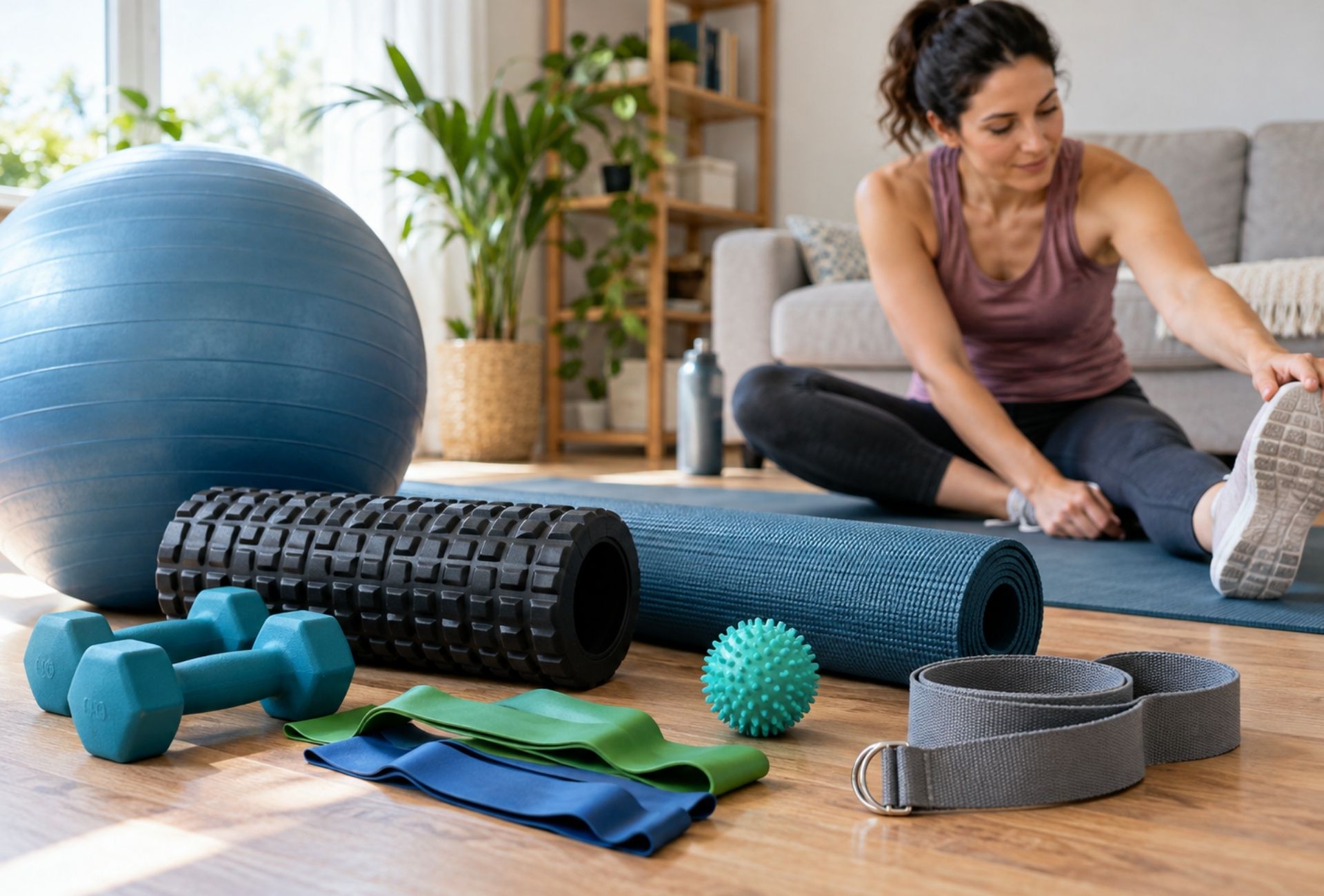
Walk through any sporting goods store and you'll find an entire wall dedicated to foam rollers, massage balls, exercise balls, resistance bands, and a dozen other self-care tools that promise to fix everything from tight hips to chronic back pain. Some of them are genuinely useful. Some aren't worth the shelf space. Here's what the evidence actually shows — and how to get the most out of the tools that do work.
Foam Rollers: What They Do and Don't Do
Foam rolling is a form of self-myofascial release — applying pressure to muscle and connective tissue using your own body weight. Harvard Health's review notes that within the context of existing research, foam rolling shows benefit for delayed onset muscle soreness, recovery, muscle fatigue, and range of motion. The effect on actual tissue structure is modest; most researchers now believe the benefit comes primarily through neurological pathways — the pressure changes how the nervous system perceives tension and pain in that area, rather than physically reshaping the tissue.
A separate Harvard Health guide on foam rolling notes that foam rollers can reduce muscle and tissue soreness, improve circulation to targeted areas, and help increase flexibility, particularly when used as a warm-up. Think of it as giving yourself a useful but limited massage — more like a first layer than a complete treatment.
Where foam rolling genuinely earns its place: as part of a warm-up before activity, and as a daily maintenance tool for people who sit for long hours or whose muscles tend to hold tension. It's also well-suited as a bridge between professional treatment sessions.
Massage Balls and Trigger Point Tools
Smaller and firmer than foam rollers, massage balls allow you to target specific points rather than rolling broad muscle groups. The NIH NCCIH review of massage therapy documents evidence for short-term pain relief from massage for low back pain, neck and shoulder pain, and osteoarthritis of the knee — and massage balls are a self-directed version of that same pressure application.
Common useful applications:
- Suboccipital muscles (base of skull): lie on your back with a ball under the base of your skull and let gravity do the work. Useful for tension headache patterns.
- Glutes and piriformis: sit on a ball and shift weight into the area. Especially useful for people with sciatic-type presentations who have tight hip rotators contributing to the picture.
- Thoracic (upper/mid back): place between shoulder blades and a wall for a sustained pressure technique.
The main limit of self-directed trigger point work is that you're applying pressure to areas you can reach and feel — which misses compensatory tension patterns in areas you can't assess yourself.
Exercise Balls (Stability Balls)
Stability balls are one of the more evidence-backed home tools for low back rehabilitation. They've been used in clinical settings to improve core activation, lumbar stability, and coordination. Basic seated balance on a stability ball recruits the deep core muscles that support the spine. From there, the tool supports a wide range of progressive rehabilitation exercises — bridges, extensions, bird-dogs, and others — that form a meaningful part of a structured rehab program.
We covered a range of these exercises in our post on rehab exercises for back pain. The limitation of the ball in isolation is the same as any self-directed tool: the exercises are only as good as the selection and execution. Poor form on a stability ball can load the spine in ways that aggravate rather than help.
When These Tools Work Best — and When They're Not Enough
Home rehab tools work best as a complement to professional care, not a replacement for it. A foam roller won't address a restricted facet joint. A massage ball won't correct a movement pattern that's loading one side of your pelvis more than the other. Stability ball exercises won't rebuild the specific muscle balance your exam shows you need if you don't know which exercises apply to your presentation.
If you've been rolling and stretching for weeks and the same area keeps tightening back up, that's a signal: the home tools are managing a symptom without addressing what's driving it. Our rehab services and massage therapy are designed to identify what's actually going on and build a plan around it. The tools you take home after that conversation are far more effective because you know which ones apply to your specific situation and why.
Frequently Asked Questions
How long should I foam roll each area?
One to two minutes per area is a reasonable starting point for most people. Longer isn't necessarily better — if you're spending five minutes on one spot, you're likely past the point of useful stimulus. Slow, sustained pressure tends to be more effective than rapid back-and-forth rolling.
Can foam rolling make things worse?
Rolling directly over an acutely inflamed or injured area can aggravate it. Foam rolling is a maintenance and recovery tool — not a treatment for acute injury. If you find that rolling a specific area consistently causes more pain rather than less, stop and have it evaluated before continuing.
Do I need expensive tools or do the basic versions work?
The basic versions work. A standard foam roller, a lacrosse ball, and a stability ball cover most of what these tools are useful for. Vibrating rollers and high-end massage guns add intensity and can be pleasant to use, but the evidence for meaningful additional benefit over standard tools is modest.
Not Sure Which Tools Are Right for Your Situation?
We're glad to put together a home maintenance routine that actually matches what your body needs.
Call 484.455.4664, book online, or contact our Limerick office — we serve Limerick, Pottstown, Royersford, Collegeville, and the surrounding Montgomery County communities.
Related care at Keep It Kinetic
- Back Pain Treatment — How we evaluate and treat low back pain in Limerick & Pottstown.
- Disc Injuries — Care for bulging and herniated discs.
- Sciatica Relief — Targeted care for radiating leg pain.
- Headache & Migraine Care
Further reading: NIH NIAMS: Back Pain