Herniated vs. Bulging Disc: What's the Difference and Does It Matter?
· Dr. Kyle Kopicki (Keep It Kinetic Chiropractic)
If you've had back or leg pain evaluated, you may have heard both “bulging disc” and “herniated disc” mentioned — sometimes about the same image. People often use the terms interchangeably, but they describe different things, and understanding the distinction can help you make sense of a report or have a more informed conversation with your provider.
What a Spinal Disc Actually Is
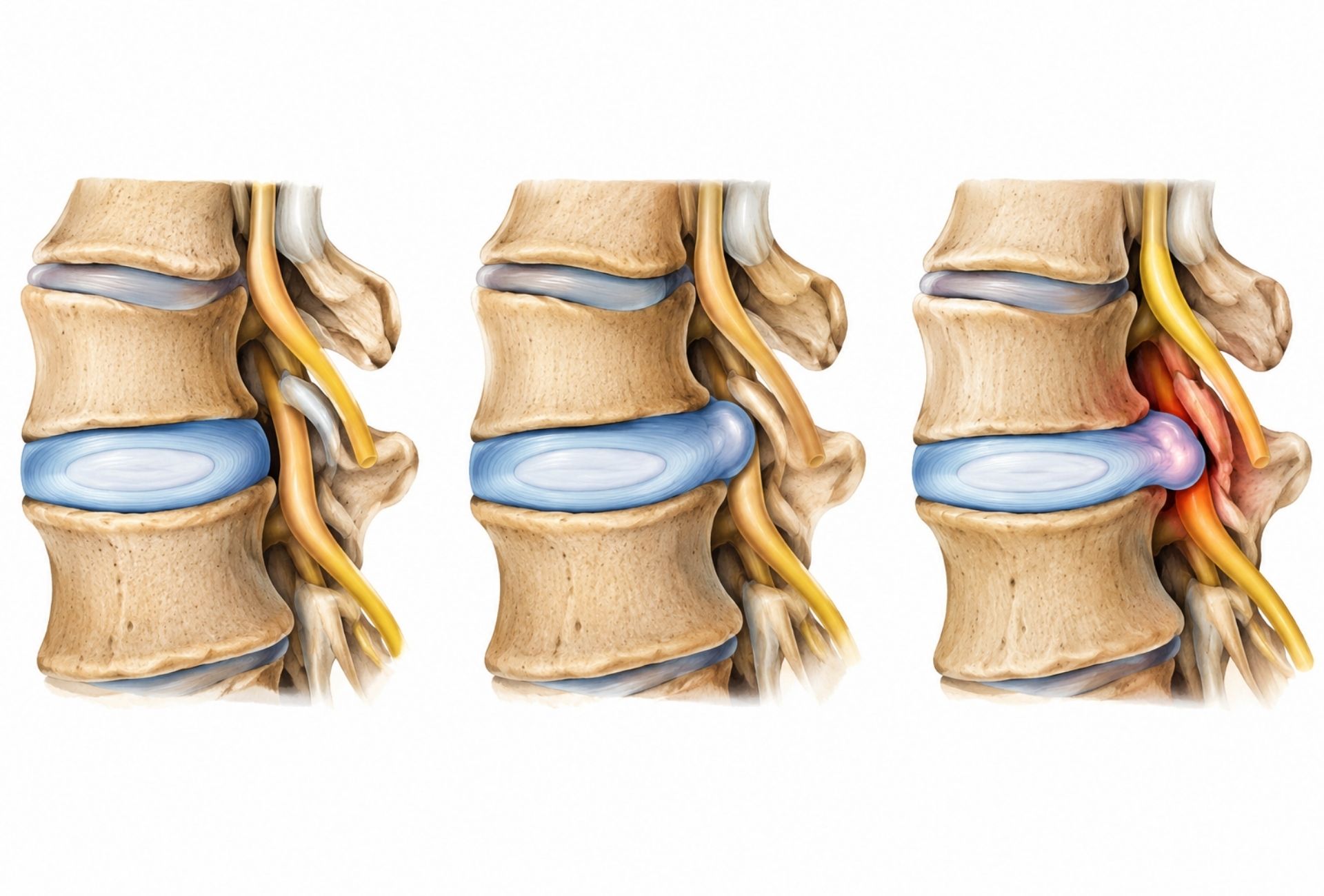
The discs that sit between your vertebrae function as shock absorbers. Each one has a tough outer shell — the annulus fibrosus — surrounding a softer, gel-like center called the nucleus pulposus. According to the Mayo Clinic, a herniated disc occurs when some of that softer center pushes out through a tear or crack in the outer shell. It's sometimes called a slipped or ruptured disc. The inner material that comes through can press on a nearby nerve, which is often what produces the symptoms people feel.
Bulging vs. Herniated: The Actual Difference
A bulging disc is different. Instead of a tear that allows the nucleus to push through, the disc simply extends outward beyond its normal edges — think of it like squeezing a hamburger and seeing the edges of the patty spread out. The outer layer remains intact. As the Mayo Clinic explains, a herniated disc sticks out farther and is more likely to irritate nerve roots, either by direct contact or by triggering inflammation around the nerve.
In practice, both can cause pain, and both can cause no symptoms at all. Imaging frequently shows bulging or herniated discs in people who feel completely fine — one of the reasons imaging is most useful when it's linked to a clinical presentation rather than ordered as a routine check.
What Symptoms They Can Cause
When a disc does cause symptoms, they depend on where in the spine it is and which, if any, nerves are affected:
- Low back discs most commonly produce low back pain, and if a nerve is involved, pain, numbness, or tingling that travels down the buttock and leg. This is the pattern most people recognize as sciatica.
- Neck discs can cause neck pain and, with nerve involvement, similar symptoms into the arm and hand.
- No symptoms at all. Many disc changes found on MRI are incidental findings in people who were imaged for a different reason. Finding a disc bulge on imaging doesn't automatically mean it's causing pain.
The American Academy of Orthopaedic Surgeons notes that most low back pain, including disc-related pain, improves significantly with conservative care over weeks to months. Surgery is rarely the first response.
When Should You Be Seen?
Most disc-related pain responds well to conservative care. An evaluation is worth scheduling promptly if you notice:
- Pain, numbness, or tingling that travels down an arm or leg
- Weakness in an arm, hand, leg, or foot
- Pain that is severe, worsening, or significantly limiting your daily activities
- Any change in bladder or bowel function — that requires immediate medical attention
How Chiropractic Care Fits In
Disc problems are among the most common presentations we see. Our first step is always a thorough history and exam to understand what's actually producing your symptoms — disc, joint, muscle, referred pain, or some combination. From there, care may include chiropractic adjustments to support comfortable spinal motion, soft tissue work for associated muscle tension, and rehabilitation exercises to build the core support that takes load off the disc. You can learn more on our disc injuries page. If your presentation suggests imaging would change your care, we'll tell you, and if it points toward medical evaluation, we'll refer you there. Our earlier post on when imaging actually helps covers the decision-making behind that.
What to Tell Your Provider — and What to Ask
When you come in with back or leg pain that may involve a disc, the most useful information you can share is: when it started, whether anything specific triggered it, what makes it better or worse, and whether the pain travels anywhere down an arm or leg. That last point matters most — disc problems that affect nerves tend to produce symptoms away from the spine, not just at the injury site.
Questions worth asking your provider: Is this actually the disc causing my symptoms, or could it be something else? Does this need imaging right now, or can we start with conservative care? What activities are safe for me to continue? Our post on when imaging actually changes care covers that decision in detail. And if sciatica symptoms are part of your picture, our sciatica page explains how that presentation fits into disc care.
Frequently Asked Questions
Will a herniated disc heal on its own?
Often, yes. The nucleus material that pushes out through a herniation can shrink over time through a natural reabsorption process, and many people improve significantly without surgery. Conservative care during that window helps manage symptoms and maintain function.
Is it safe to have a chiropractic adjustment with a herniated disc?
It depends on what the exam and, if needed, imaging shows. Some presentations are well-suited to chiropractic care; others require a different approach or co-management with another provider. We'll tell you plainly which category you fall into.
Why does my imaging report say “disc desiccation” or “degenerative disc disease”?
These terms describe age-related changes in disc hydration and height that are common in adults and don't necessarily correlate with pain. Degenerative disc disease in particular is largely a radiological description, not a diagnosis that predicts your outcome. The clinical picture — what you're feeling and how it's affecting you — matters more than the label on the report.
Dealing With Disc Pain?
Let's sort out what's actually driving it and build a plan from there.
Call 484.455.4664, book online, or contact our Limerick office — we serve Limerick, Pottstown, Royersford, Collegeville, and the surrounding Montgomery County communities.
Related care at Keep It Kinetic
- Back Pain Treatment — How we evaluate and treat low back pain in Limerick & Pottstown.
- Neck Pain Care
- Whiplash Treatment
- Massage Therapy
Further reading: NIH NIAMS: Back Pain