
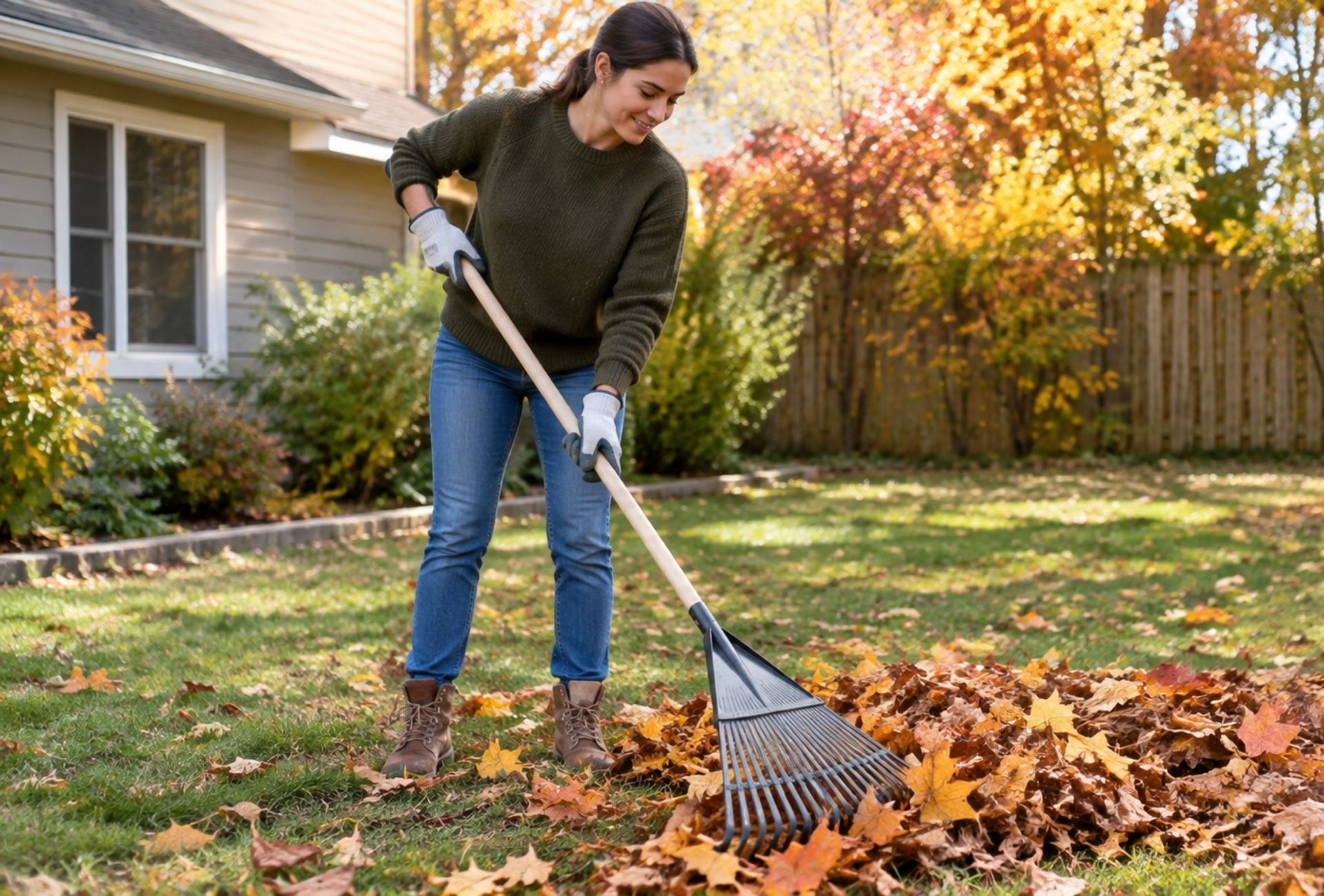
Raking leaves is one of those chores that doesn't feel like exercise until two days later when you can't straighten up. Every fall we see a wave of back, shoulder, and neck complaints from people who spent the weekend doing yard cleanup — and most of them were surprised it hit as hard as it did.
Why Raking Is Harder on Your Body Than It Looks
The mechanics of raking are genuinely demanding: you're repeatedly twisting the spine, reaching forward with weight in your hands, bending to collect piles, and lifting loaded bags. The Johns Hopkins Medicine guide on raking safety notes that the bending, reaching, twisting, lifting, and carrying involved can easily produce muscle strains — especially in the shoulders, back, and neck, and especially if those muscles aren't conditioned for it. When you haven't raked since last fall, that's almost everyone.
The most common injury pattern is a sprain or strain in the low back or shoulder, often from the twisting motion. Keep the rake close to your body, avoid rotating the trunk while pulling, and try to lead with your arms and shoulders rather than jerking with the back.
Smart Technique Makes a Real Difference
The American Academy of Orthopaedic Surgeons offers practical guidance on protecting your back during home and yard work that applies directly to raking season:
- Warm up first. Even ten minutes of light walking and gentle stretching before you pick up the rake can reduce your strain risk. Cold muscles don't absorb load as well as warm ones.
- Use the right rake. Choose a handle length appropriate for your height so you're not hunching forward to reach the ground. Ergonomic curved handles reduce the bend required.
- Switch sides. Raking one-sided puts all the torque on the same shoulder and hip. Switch your grip and lead hand every few minutes.
- Don't overfill bags. A bag of wet leaves is surprisingly heavy. Fill bags partially and lift with your legs — feet shoulder-width apart, back straight, no bending at the waist.
- Take breaks. This is an aerobic activity. Frequent short breaks are better than pushing through fatigue, which is when form breaks down and injuries happen.
The Bag Lift Is Where Most Injuries Happen
Most people are careful while raking but get careless when it's time to move the bags. The Cleveland Clinic emphasizes keeping heavy items close to your body, bending at the knees rather than the waist, and avoiding any combination of lifting and twisting at the same time. That last point matters: the spine is weakest when rotated under load. If a bag is too heavy to move comfortably, split it into two.
When the Soreness Doesn't Clear Up
Some muscle soreness the day after a big yard-work session is normal — similar to what we covered in our post on weekend warrior recovery. What you're watching for instead is sharp or one-sided pain, pain that radiates down a leg or arm, or soreness that isn't clearly improving after about a week. Those patterns warrant an evaluation rather than waiting them out.
How Chiropractic Care May Help
A yard-work strain that doesn't resolve on its own usually involves more than just sore muscles — often a restricted joint or an irritated segment of the spine is adding to the picture. A thorough exam can identify what's actually driving your symptoms. From there, chiropractic adjustments may help restore comfortable motion, massage therapy can address tight, overworked muscles, and targeted rehab exercises can help build the strength that makes the next raking season easier. If it's your lower back taking the hit, our back pain page covers how we approach those presentations.
Setting Up Next Year Before You Put the Rake Away
The best investment you can make now is working on core and hip strength through the winter so next fall's yard work doesn't start from zero. Even consistent walking, a few targeted exercises per week, and keeping mobile through the cold months make a meaningful difference in how your body handles heavy seasonal chores. If you're not sure where to start, our rehab services team can put together a program that fits your schedule and targets the specific areas yard work tends to strain most — usually the low back, hips, and shoulders.
Frequently Asked Questions
How long should post-raking soreness last?
Typical muscle soreness from yard work peaks one to two days after and eases over the following several days. Sharp, localized, or worsening pain — or soreness that persists well past a week — is worth having evaluated rather than waiting out.
Should I use heat or ice after raking?
For general muscle soreness, heat tends to feel better and helps tight muscles relax. Ice is more useful for acute inflammation or swelling immediately after an injury. Use whichever brings relief in short sessions.
Is it worth seeing a chiropractor for a yard-work strain?
If the soreness is improving steadily on its own, you may not need to. If it's not improving, if the pain is sharp or radiating, or if it keeps coming back every yard-work season, an evaluation can identify what's actually going on and help you address it rather than repeat the same injury.
Back Acting Up After a Weekend in the Yard?
Let us take a look before it becomes a longer-term problem.
Call 484.455.4664, book online, or contact our Limerick office — we serve Limerick, Pottstown, Royersford, Collegeville, and the surrounding Montgomery County communities.
Related care at Keep It Kinetic
- Disc Injuries — Care for bulging and herniated discs.
- Sciatica Relief — Targeted care for radiating leg pain.
- Shoulder Pain Treatment
- Bursitis Care
Further reading: NIH NIAMS: Back Pain