What Is Instrument-Assisted Soft Tissue Mobilization and Who Can Benefit From It?
· Keep It Kinetic Chiropractic
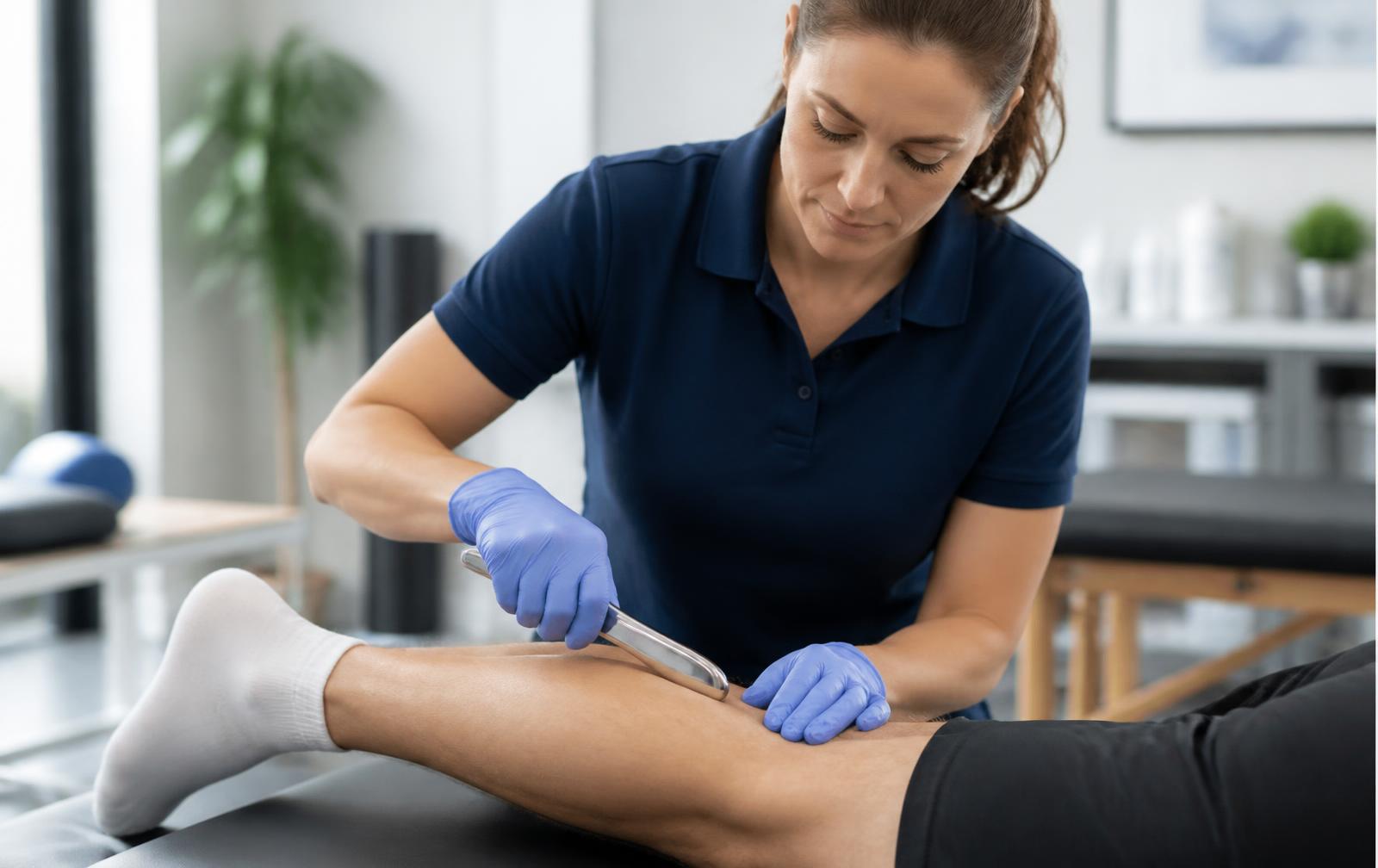
If stretching and rest have not loosened a stubborn spot in your calf, forearm, or shoulder, the problem may not be the muscle itself — it may be the tissue around it. Instrument assisted soft tissue mobilization (IASTM) is a hands-on technique that uses smooth stainless steel tools to work through those restrictions more precisely than fingers alone can.
At Keep It Kinetic Chiropractic in Limerick, PA, Dr. Kyle Kopicki is trained in the M1 and M2 Graston Technique methods and uses IASTM alongside adjustments, rehab, and massage for patients across Limerick Township and Pottstown.
What Is Instrument-Assisted Soft Tissue Mobilization?
IASTM is a form of manual therapy performed with beveled stainless steel instruments. The provider glides the tool along the skin over muscle, tendon, and fascia, using controlled pressure to find and treat areas that feel gritty, thickened, or restricted.
Those restrictions often develop after an injury, a surgery, or years of repetitive movement. Instead of gliding smoothly, layers of tissue start to stick together, and the result is familiar: limited range of motion, a pulling sensation at end range, and pain that keeps returning to the same spot.
The tool does two things a hand cannot do as well. It gives the clinician clearer feedback about where the restriction actually sits, and it lets them apply focused shear force to a small area without fatiguing their hands.
How Does It Work?
The working theory is mechanical and biological at once. Controlled pressure creates a mild, targeted inflammatory response in the treated tissue, which appears to stimulate fibroblast activity and collagen remodeling — essentially prompting the body to reorganize disorganized scar tissue into something that glides again. Increased local blood flow supports that repair process.
Research on IASTM is still developing. Systematic reviews such as this review of IASTM in musculoskeletal practice report the most consistent short-term gains in range of motion, with less certainty around long-term pain outcomes. That is why we treat it as one tool inside a plan — not the whole plan.
What Does a Session Feel Like?
We apply a light emollient, then stroke the tool over the treatment area for roughly five to ten minutes. You will feel pressure and a scraping sensation, strongest where the tissue is most restricted. It should be tolerable — tell us if it is not, because more pressure is not better.
Mild redness is normal and usually fades within a day. Occasional light bruising can happen. Most patients notice easier movement immediately after treatment, and we follow it with movement work so the new range gets used.
Who Can Benefit From IASTM?
- Tendon pain that will not settle — tennis elbow, golfer''s elbow, Achilles tendinitis, patellar tendinitis.
- Plantar fasciitis and chronic heel or arch tightness.
- Post-surgical or post-injury scar tissue restricting motion months after healing.
- Athletes managing recurring calf, hamstring, quad, or shoulder tightness through a season.
- Desk workers with forearm, upper back, and neck restrictions from long hours at a keyboard.
- Limited range of motion that stretching alone has stopped improving.
IASTM is usually not appropriate over open wounds, active infection, recent fractures, areas of unexplained swelling, or for people on blood thinners without medical clearance. Certain skin conditions and cancers are also contraindications. We screen for all of this before your first treatment.
How It Fits With the Rest of Your Care
Freeing up restricted tissue creates an opening. What matters is what you do with it. In our office, an IASTM session is typically paired with chiropractic adjustments to restore joint mobility, then with rehab and corrective exercise so the surrounding muscles learn to hold the new range. For patients who need broader relaxation and circulation work across a whole region, massage therapy often complements it well.
That layered approach is standard in conservative musculoskeletal care. The National Center for Complementary and Integrative Health notes that manual therapies tend to work best as part of a multimodal plan that includes active movement.
How Many Sessions Will I Need?
Most soft tissue complaints respond within four to six visits, often spaced a few days apart at first. Long-standing scar tissue can take longer. If you are not seeing measurable change in range of motion or pain after a few sessions, that is useful information — we adjust the plan rather than repeating something that is not working.
Talk to a Limerick Chiropractor About IASTM
If a nagging soft tissue problem has outlasted rest, ice, and stretching, instrument-assisted soft tissue mobilization may be worth a look. No contracts or long care plans required — just an honest evaluation and a clear recommendation.
Serving Limerick Township, Pottstown, Royersford, Collegeville, and the surrounding area. Schedule online or call or text our office to get started.
Related care at Keep It Kinetic
Further reading: AAOS OrthoInfo: Shoulder Problems